

Creating the Right Answer: The Fulcrum EVOLVE™ Framework for Pharmaceutical Positioning
Introduction: The Wrong Question
Pharmaceutical market research is often designed to answer a simple question:
Which positioning should we choose?
But this is the wrong question. We believe the role of research is not to choose the best option—it is to create it.
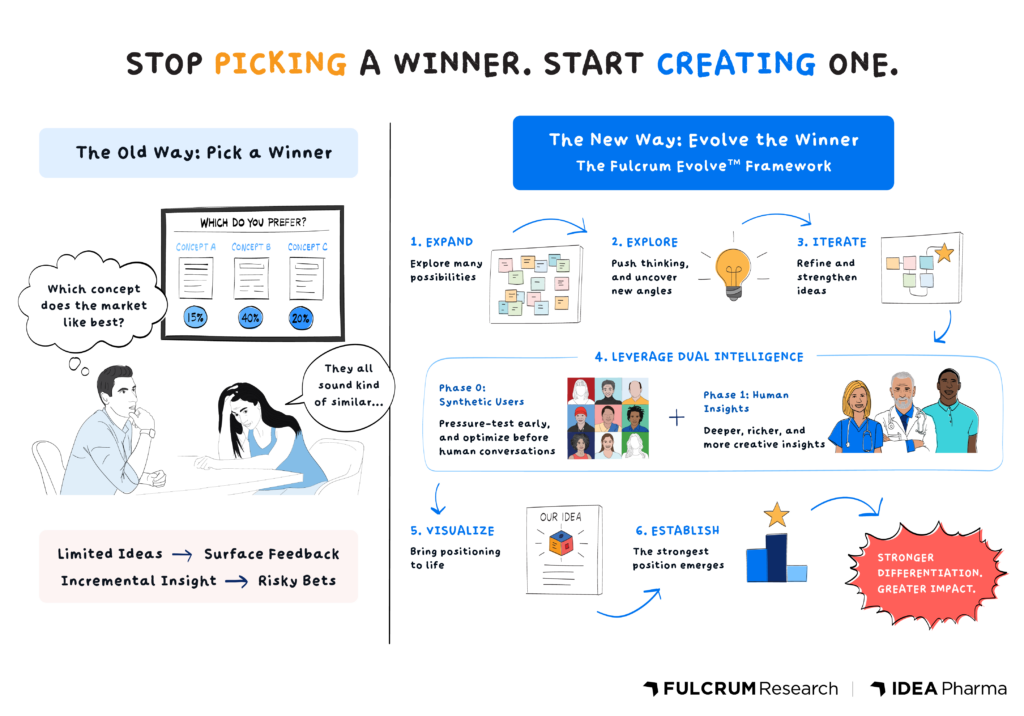
In partnership with our sister division, IDEA Pharma, Fulcrum applies a philosophy grounded in real-world launch success: breakthrough positioning does not emerge from testing—it emerges from exploration, iteration, and expert-led thinking.
Why Traditional Research Falls Short
Most research approaches assume that:
- The market can articulate what it wants
- Respondents can evaluate concepts in isolation
- The best idea can be identified through testing
However, in reality:
- Customers often recognize value when they see it, rather than describe it upfront
- Respondents are constrained by existing mental models
- Testing static concepts leads to incremental optimization, not true differentiation
This is why so many assets end up positioned as: “similar to what exists—just slightly better”
A Different Philosophy: Don’t Pick a Winner—Build One
Through IDEA Pharma’s positioning framework, we adopt a fundamentally different approach:
The goal of research is not to select a winner, but to evolve one.
Rather than narrowing prematurely, we:
- Start with multiple distinct positioning directions
- Explore how each could succeed in-market
- Use research to refine, reframe, and strengthen ideas
Because the most valuable insights often emerge from unexpected reactions, not predefined answers
From Concepts to Prototypes
Traditional research inputs—TPPs, message boards, and static concepts—limit thinking.
Instead, we introduce positioning prototypes:
- Fully formed, multi-dimensional “ways the product could exist”
- Including value proposition, target, competitive framing, and use-case
This aligns with IDEA Pharma’s concept of an “IDEA”—a testable hypothesis with possibility, desirability, and differentiation
Why this matters:
- Respondents move from evaluation → imagination
- They react to a future reality, not a feature list
- They reveal latent needs, behaviors, and opportunities
Redefining the Research Process
A core challenge with this strategic, early-stage research is that:
- Teams often enter with too few ideas
- Or with ideas that are underdeveloped or biased
To help push further into ideation and exploration, we incorporate both Phase 0 (Synthetic) and Phase 1 (Human) research into the process.
Phase 0: Synthetic Exploration
- In collaboration with our tech partner, Synthetic Users, we generate and pressure-test multiple positioning prototypes with synthetic respondents first.
- Synthetic respondents are AI-generated representations of people that engage with us in an interactive interview-based conversation.
- This enables us to explore many more pathways than we could with human respondents. Through this iterative process, we identify weaker ideas and optimize stronger ones for future pressure testing.
- While real people are essential to validate real-world nuance, Synthetic Users help us create a more informed, efficient, and productive human research phase.
- Given how fast Synthetic Users are to interview, we’re typically able to run a “Phase 0” research phase without adding additional time to the overall project.
Download the Synthetic Users report here to learn more about our AI Market Research platform.
Phase 1: Human Exploration
The core part of the market research, here we explore reactions, behaviors, and implications to the ideas we’ve identified as having potential and set ourselves up to better understand how to evolve those ideas into a final positioning.
This requires not just moderation and regurgitation of what respondents said. It requires expert facilitation and interpretation. At Fulcrum, our researchers are trained to:
1. Reframe Data into Meaning
Translate clinical endpoints into real-world value:
- Not “+25% improvement”
- But “delays progression in a way that changes treatment goals”
2. Drive Creative Thinking
We:
- Introduce possibilities
- Push beyond first reactions
- Explore “what else this could be”
3. Challenge Assumptions
We actively test:
- What truly matters vs. what is assumed to matter
- Value across the full competitive context, not just class comparators
4. Identify Signals Beneath the Surface
We focus on:
- Why respondents react the way they do
- What unexpected insights reveal about future opportunity
5. Iterate in Real Time
Each interaction informs:
- Refinement of prototypes
- Development of stronger positioning directions
Creating a Darwinian process where the strongest idea emerges over time
Phase 2: Iteration & Convergence
Leveraging insight from both AI and human respondents, we build stronger IDEAs and bring them back for final Synthetic User testing to help with any last optimizations. We emerge with a positioning platform that has benefited from multiple iterations from multiple audiences, and confidence that through the process we have created:
- Strong differentiation: moving from “better” to meaningfully different
- Greater confidence: Decisions grounded in explored possibilities, not limited choices
- More efficient decisions: Better inputs, better conversations, faster clarity
- Actionable insight: Understanding not just what resonates, but why
Conclusion: From Testing to Creating
The future of pharmaceutical market research is not about asking better questions of the market. It is about:
- Bringing better possibilities to the market
- Exploring them more intelligently—before and with human input
- And using expertise to turn insight into advantage
The goal is not to pick a winner—but to ensure the best possible idea is the one that remains. To ensure that when a decision is made, it is not a compromise—
but the result of an exhaustive, creative, and strategic search for the strongest possible positioning.